
Table of Contents
ToggleWhat are the Different Age Groups?
Introduction: Age Groups and Their Importance
At every stage of life, our needs, behaviors, and experiences evolve. That’s why we often use different age group labels—such as “babies”, “teens”, or “seniors”—to describe people at different stages of life. These labels help us categorize individuals by age for clearer communication and better understanding.
Understanding and naming age groups is essential in many areas of life:
🏫 Education: Creating age-appropriate learning materials and teaching methods.
🩺 Healthcare: Providing care that suits physical and emotional development.
💼 Marketing: Creating products and advertising targeted to specific age groups.
🧠 Psychology and social sciences: Studying behavior, growth, and human development.
By the end of this blog, you will have a clear understanding of the categories of standard age groups, their common names, and their usage in different fields.
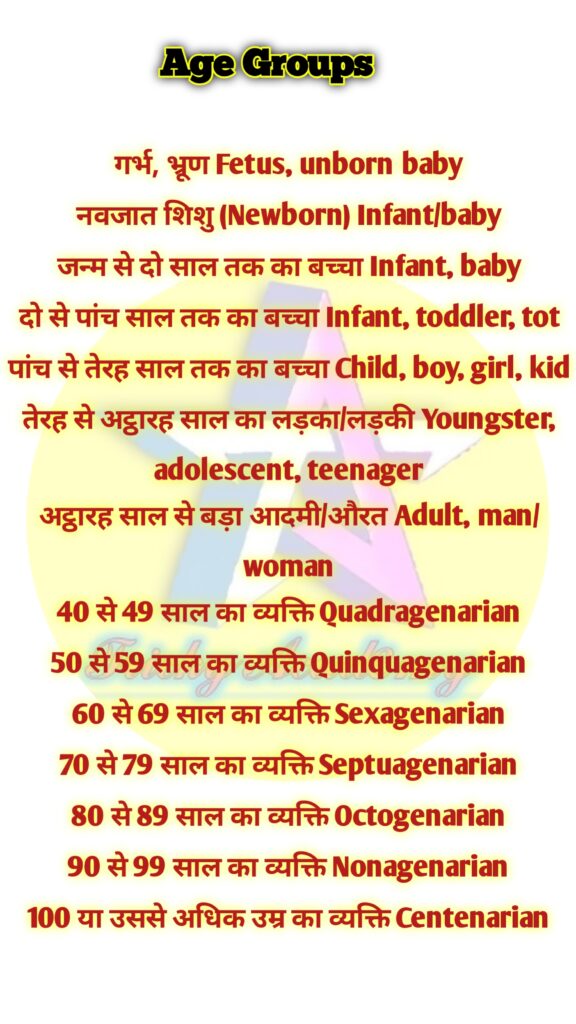
Age Groups Classification
- गर्भ, भ्रूण – Fetus, unborn baby
- नवजात शिशु – (Newborn) Infant/baby
- जन्म से दो साल तक का बच्चा – Infant, baby
- दो से पांच साल तक का बच्चा – Infant, toddler, tot
- पांच से तेरह साल तक का बच्चा – Child, boy, girl, kid
- तेरह से अट्ठारह साल का लड़का/लड़की – Youngster, adolescent, teenager
- अट्ठारह साल से बड़ा आदमी/औरत – Adult, man, woman
- 40 से 49 साल का व्यक्ति – Quadragenarian
- 50 से 59 साल का व्यक्ति – Quinquagenarian
- 60 से 69 साल का व्यक्ति – Sexagenarian
- 70 से 79 साल का व्यक्ति – Septuagenarian
- 80 से 89 साल का व्यक्ति – Octogenarian
- 90 से 99 साल का व्यक्ति – Nonagenarian
- 100 या उससे अधिक उम्र का व्यक्ति – Centenarian
Infancy to Childhood
| Age Range | Group Name | Notes |
|---|---|---|
| 0–1 year | Infant / Baby | Newborn to toddler stage |
| 1–3 years | Toddler | Learning to walk/talk |
| 3–5 years | Preschooler | Early childhood |
| 6–12 years | Child | Middle childhood |
Teenage / Adolescence
| Age Range | Group Name | Notes |
|---|---|---|
| 13–15 years | Early Teen | Transitional phase |
| 16–19 years | Teenager / Adolescent | Emotional & physical development |
Young Adulthood
| Age Range | Group Name | Notes |
|---|---|---|
| 20–24 years | Young Adult | College/early career phase |
| 25–35 years | Adult (Early 30s) | Independent, career-building |
Middle Age
| Age Range | Group Name | Notes |
|---|---|---|
| 36–45 years | Early Middle Age | Peak career/family years |
| 46–55 years | Midlife | Transitional period |
Older Adulthood
| Age Range | Group Name | Notes |
|---|---|---|
| 56–64 years | Mature Adult | Pre-retirement phase |
| 65–74 years | Senior / Young-Old | Active retirement |
| 75–84 years | Elderly / Middle-Old | Reduced activity |
| 85+ years | Oldest Old | Advanced age |
✅ Conclusion:
From the soft squeals of a baby to the wisdom of old age, each stage of life has its own identity, challenges, and beauty. In this post, we explore the names of different age groups—from infancy, childhood, and adolescence to adulthood and old age—as well as how and why these categories are used.
Understanding age groups helps us:
Communicate more effectively
Provide age-appropriate care, education, and services
Appreciate the unique qualities of each stage of life
Whether you’re a student, a teacher, a healthcare worker, or just curious, knowing the classification of ages can help you better understand those around you.
💬 Now it’s your turn!
Do you feel more connected to a particular age group than your actual age? Have you seen age group labels used differently in your culture or profession?
Share your thoughts or experiences in the comments below!